Showing posts with label STEM. Show all posts

Tuesday, July 21, 2015

BioSim at the Boys and Girls Club of Ellettsville

A post by Alex Dailey and Sam Lorentz

A couple of weeks ago the Creativity Lab’s BioSim Project ran some preliminary testing at the Boys and Girls Club of Ellettsville. Our team used this time to critique our research methods.
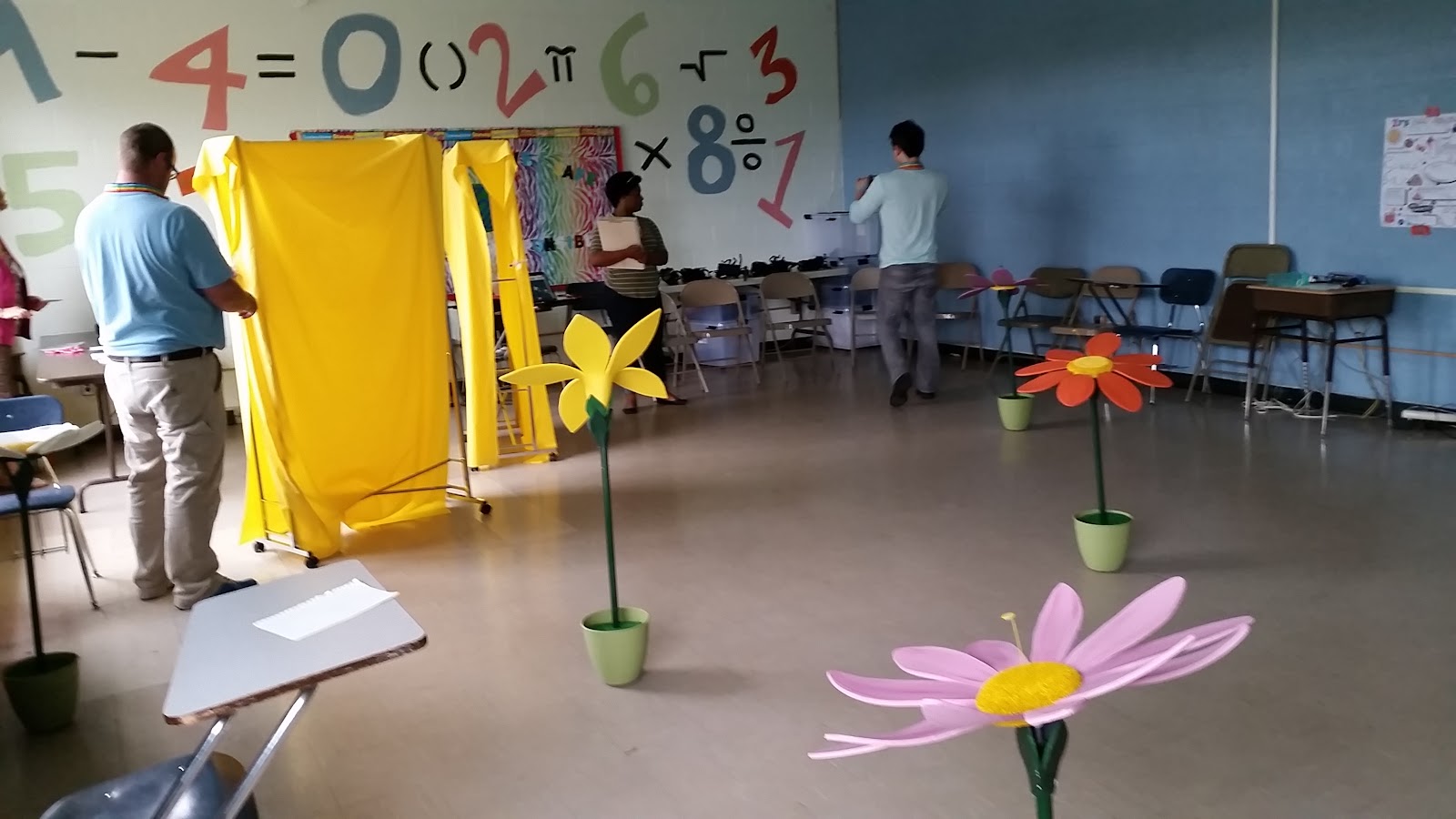
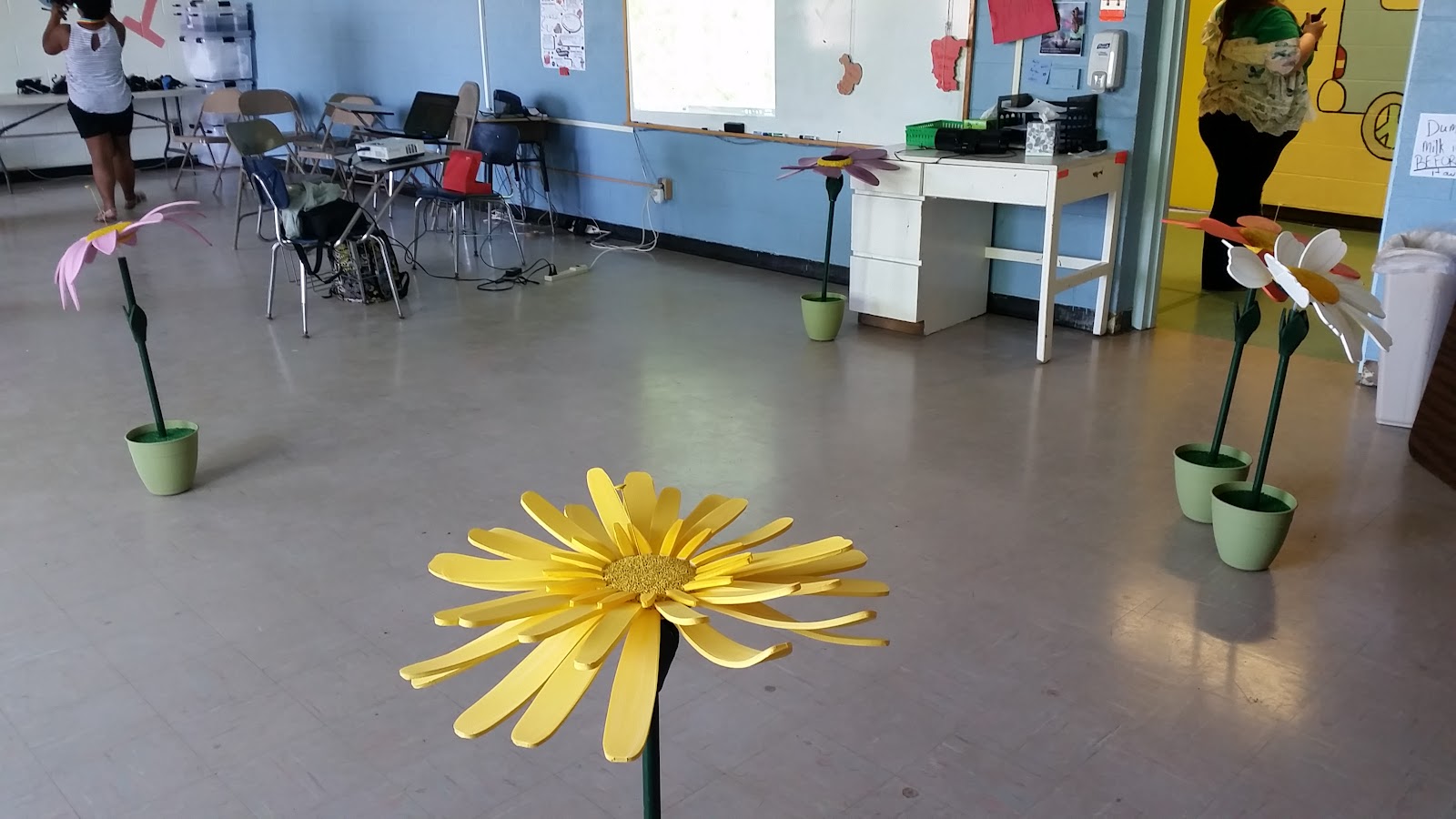
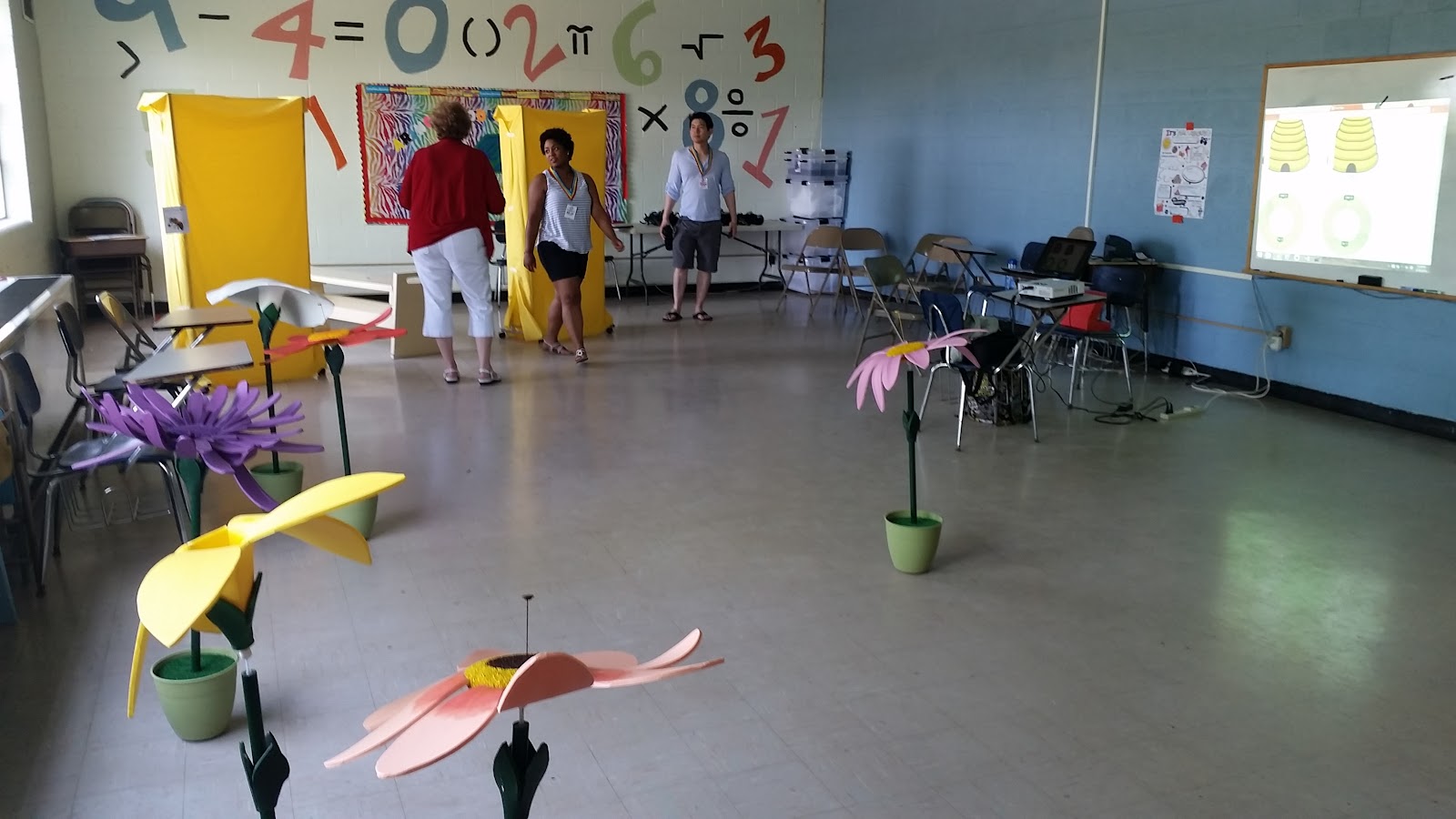
The BioSim team spent four days with the kids at the Club.  They closely examined how the kids reacted to each part of the exercise. Over the four days the kids learned about how honey bees feed themselves by collecting nectar and making it into honey.  The kids then simulated this process with electronic bee puppets.  They took turns searching for flowers with the most nectar.  At first their nectar searching was random.  Each kid spent a lot of time searching through each flower to find the ones that had more nectar.  Many times the kids searched so long that their bees ran out of energy and died before they could make it back to the hive.  We began to teach them that bees communicate the location of nectar with each other.  At first we let the kids tell each other where to find the most nectar.  This time they collected more nectar and none of the bees ran out of energy.


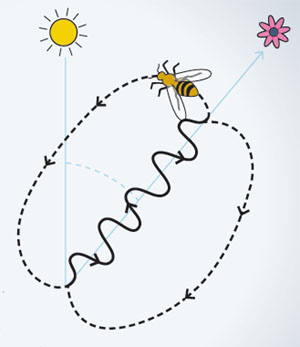
Honey bees communicate by dancing.  The do a sort of waggle up the middle then either turn right or left and loop back.  By doing this they communicate to other honey bees the distance and direction of flower with a lot of nectar.

waggle-dance.jpg       https://upload.wikimedia.org/wikipedia/commons/4/4b/Bee_waggle_dance.png
The waggle dance: By doing their dance, honey bees communicate to each other the location of flowers with lots of nectar based on the angle between the sun, hive and flower.

We challenged the kids to create their own dances to tell each other where the flowers with the most nectar were.  At first the kids had trouble gathering their thoughts.  Some kids tried to make up dances as they went along and others didn’t know what dance their hive was doing from the beginning.  As time went on they learned that without a descriptive dance that everyone could understand, they weren’t effective at collecting nectar.
On the final day of our visit one girl took her bee dance to the next level.  She took it upon herself to teach the rest of her hive a dance that mimicked the one that the actual honeybees do.  She wiggled up the middle then looped back either on the left or right to signify the direction and distance of the flower with the most nectar.  As a result of her creative thinking her hive collected more nectar and won the competition.  
20150610_154713.jpg20150608_141130.jpg


By the end of our time with the kids it seemed like they had grasped a strong understanding of the complex system of honey bees. The world is made up of complex systems, which makes it imperative that students learn to understand them.  Young kids are continually underestimated in their cognitive abilities yet they are able to understand the complex system of honey bees.  

20150610_154959.jpg

We were pleased with how our preliminary testing went last week but we also discovered multiple things for us to improve upon.  Thanks to the Boys and Girls Club of Ellettsville, we are one step closer to a successful implementation.

Friday, June 26, 2015

Welcome Sam Lorentz! - Creativity Labs Introduces New Undergraduate Members

This June, the Creativity Lab Team has introduced two new undergraduate members to the lab, Alex and Sam.  They are both working with the BioSim Project and are eager to get started.

--A post by Sam Lorentz

I’m Sam and I am studying Biology, with minors in Psychology, Chemistry, and Biochemistry, at Indiana University.  In the fall I will begin my Junior year. I’m an Evans Scholar as well as a member of the Indiana University Swim Team.
The Creativity Labs initially interested me because of my strong desire to get involved in research.  As I’ve progressed through my science major, my interest in the entire process of research, from formulating questions and hypotheses to publication, has grown.  After hearing about the CL and all it’s innovative work I was certain it was something I wanted to be involved in.  
I have spent several summers working as a swimming instructor.  I have worked with large groups and individuals ranging from 4 to 12 years old.  I really enjoyed getting to work with kids of various age groups on a day to day basis.  My most effective lessons were when I made the learning and swimming fun for the kids.  After learning this I’m very excited to start working in the field with the BioSim play to learn model.  Additionally, I have experience working as an Undergraduate Teaching Assistant in the Biology Department at IU. The Biology students I worked with gave me the opportunity to further my teaching abilities while enhancing my speaking skills. The CL gives me the opportunity to combine research and my experience with children and as a teaching assistant to a single place that’s changing the way we think about education and cognitive development.
With this excellent opportunity to work with such a qualified team, I am hoping to further my own abilities as a researcher, find out if research is something I want to pursue long term, and to make a contribution to science and education.  If I were to pursue research after graduation I could see myself working in some sort of cognitive development lab or a biology lab.  I’m particularly interested with the human brain as well as the molecular side of biology.  Working on the BioSim project is some of the best experience I can get, especially if i pursue cognitive development.  
As I’m getting started I’m most excited to start working with kids.  I really think that the research here is making a huge difference for kids, both immediately and in the future of education.  The complex systems that we work with have incredibly broad applications.  By helping young students to master them now, we are creating more thoughtful adults and future scientists that could eventually make revolutionary discoveries.  

Tuesday, June 23, 2015

Welcome Alex Dailey! - Creativity Labs Introduces New Undergraduate Members

This June the Creativity Lab Team has introduced two new undergraduate members to the lab, Alex and Sam.  They are both working with the BioSim Project and are eager to get started.

--A post by Alex Daily


I’m Alex, and I am studying Human Biology with a Concentration in Human Health and Disease and minors in Biology and Chemistry.  I am entering my junior year at Indiana University and I am also apart of the Hudson and Holland Scholar Program.
I was initially drawn to join the Creativity Labs because of my desire to do research that involved children and the mental capabilities that they possess.  My prior research experience differs greatly.  I first started doing research my junior year in high school doing field work with an ecology biology professor. I found this experience to be really helpful especially when it came time to decide where I wanted to attend school.  I was able to build upon the knowledge that I had acquired through basic science classes help my professor advance in her study of fish in the local ecosystem. My research has also brought me to a lab though the evo-devo department at IU; The Mozcek Lab.  With these experiences I have gained a passion for research and aspire to continue growing as a researcher and with the opportunity from the Creativity Labs I plan to do just that.


My past experiences with children also played a role with me joining the Creativity Lab.  I have experience as a summer camp counselor working with children from the ages of 4-17. This allowed for experience with many different age groups.  I was able to tailor different skills to fit the personalities and capabilities of all children that I worked with.  The experience also showed me that I enjoyed working with younger children and helping them grow and develop socially and mentally.  I also have experience as a peer assistant which gave me the opportunity to develop my skills as a leader and as a creative individual in terms of implementing plans and ideas.
CL allows me to take my past experiences and my hopes of being a pediatric neurosurgeon and researcher and put them to use.  I am able to see how I can help children learn complex systems and ideas and really understand in depth what connections their brains are making.  I am also able to help shape and mold minds for tomorrow, so that not only are children understanding material, but they also gain a desire and passion to go and solve new problems in the world and become the scientists and researchers that this world needs in order to progress humanity, this is what I am most excited about in terms of BioSim; watching the children come to the realization that through creative learning and various creativity methods that they too can understand complex ideas.

Saturday, May 23, 2015

Summer 2015 Service Kick-Off!


This past Friday, we hosted a hands-on exploratory workshop at Clifty Creek Elementary School’s STEM Fair in Columbus, IN. Given the drop-in and walk-by atmosphere of a fair, we wanted to offer a project that is easy to create but at the same time offers all of the circuitry learning benefits of the electronic textiles toolkit. We offered one of the many e-textiles activities documented in our colleague Leah Buechley’s book Sew Electric, the light-up bookmark, and another project we made up on the fly while preparing for the workshop, a light-up bow. However, much of the preparation was done in coordination with the Clifty Creek Elementary School teachers, who also provided materials for the workshop, including electronic components and crafting supplies.

E-textiles are electronics embedded into clothing, accessories, or other wearables. In the Creativity Labs, we like to use the LilyPad Arduino toolkit, which includes sewable LEDs, battery holders, and microcontrollers that can all be connected with conductive thread. This provides opportunities to combine both high- and low-tech, both crafting and electronics, and represents an unusual and very powerful approach to learning circuitry and programming that tends to be more inviting to girls. The Creativity Labs is always happy to share e-textile workshops with our partners!
 
The Clifty Creek STEM Fair was an informal after-school field day, kind of like an open house, for families and people of all ages to enjoy the pre-Memorial Day Friday. Throughout the fair, barbecue grills, face painting, and moonbounces gave the festival a true Mini Maker Faire vibe, that was sprinkled with science explorations at every corner of the schoolyard and house. The focus of the Fair was many science-themed activities, such as our e-textiles workshop.
E-sewers hard at work!
 
Our workshop was set up in Ms. Lucas’s 3rd-grade classroom. To create light-up bookmarks, we provided various materials to the visitors of our table. These included fabric strips, felt stickers, bows, conductive thread, sewable LEDs, sewable battery holders, and batteries. Many children gathered at various tables with their parents and embarked on highly imaginative creations, which included various patterns with stripes, hearts, and happy animals. The children were captivated by the lights sewn into the fabric, but naturally, many lacked experience with sewing and needed assistance from adults. Thus, parents were highly involved; while children focused on the imagination, decoration, and connectivity of the circuits, any parents who were present primarily helped with the stitching and knot-tying.
 

The classroom setup
The drop-in nature of the workshop provided many interesting facilitation challenges. For instance, our workshop was very popular and attracted more youth than the two facilitators could address at the same time. Many participants were excited by the prospect of bookmarks that lit up, so they got ahead of themselves before one of the facilitators could provide instructions on the next step, and even made some mistakes when connecting the circuits. Backtracking was necessary, but this simply led to even deeper circuitry learning. Excited about the decorative possibilities, but confronted with limited time towards the end of the day, some of the children did not finish their e-textiles projects at the table. We provided them with little take-home bags filled with samples of conductive thread, a battery and some decorative craft materials. One of the mothers said that this might be a fun evening at home finishing the project together with her children. We hope to further explore how to improve facilitation of drop-in e-textile workshops.


Given this great start to the Creativity Labs' summer service activities, we are excited about the other upcoming opportunities to interact and share our learning with the local community in and around Bloomington, IN, and, in fact, throughout the country. Here is a list of some of the events we are looking forward to: