Showing posts with label Makerspace. Show all posts

Tuesday, June 2, 2015

Fiber Arts: Sewing with Gail Hale


A post by Sophia BenderTony PhonethibsavadsNaomi Thompson, and Anna Keune

This is the first in a series of blog posts about the Creativity Labs’ fiber arts summer workshops. Tucked away on the eastern side of Bloomington, the CL team attended a workshop to learn how to use the sewing machine by artist, self-proclaimed maker and innovative recrafter, Gail Hale. Gail worked with the Creativity Labs team several times in the past, including assisting the creation of a cosplay costume as part of the Re-Crafting Mathematics project. This project was the overall frame for our sewing workshop at her private makerspace. As an artist of the Discardia group, that repurposes discarded materials into refashioned wearables, our workshop project was in true discardia style: sewing a grocery bag out of sheer synthetic fabric, which was repurposed from curtains.

The wonder-filled studio, with painting and dried out beehives dangling from the ceiling right over mannequins wearing hats and dressed in fashion projects in progress and former Trashion Refashion outfits, a fridge covered with reused magnets and shelves stacked with fabrics for projects to come, we gathered around a large and heavy wooden table, eager to learn.

To get started, Gail laid out the metal pattern used to cut the bag-shaped cloth for the project. The sheer fabric was slippery, and Gail fastened the pattern tightly onto the fabric, using old metal irons and pieced of railroad tracks that she gathered and cut apart years ago from a former workshop. To prevent the fabric from fraying, Gail recommended to use a woodburning tool to cut the fabric along the metal pattern, neatly sealing the synthetic fabric’s edges.


From left to right: Metal irons and railroad track pieces hold down the pattern. Kate practices her cutting skills. Kate adjusts the fabric before sewing.

Next, it was our turn. Rotating around the group, one by one, each of us carefully stepped towards the pattern and cut a small area. While this is a rather unconventional method for cutting fabric, it was an innovative use for old tools, underscoring Gail’s spirit of making. Moving forward, to save time, Gail provided each with pre-cut fabric pieces. 

Janis at Gail’s old Singer machine.

Ready to get our hands on the sewing machines, we all followed the same order to sew our shopping bags. First, we sewed up each of the sides, before moving on to the handles. Some of us decided to sew two “triangles” into the inside bottom of the bags to create a flat bottom and we learned a new term from our newest team members, Ed Gentry: We called this boxing it up. For the handles, Gail suggested a really neat trick to provide extra reinforcement and to flatten the seams so they would lie comfortably against your shoulder. This involved sewing along the handles once, then opening the seam and sewing each side down. However, some of us had sewed our seams too tiny to use this technique! She also said the sides of the triangles be sewn down to provide a more finished, secure look. Some of us opted to do that, and some didn’t.

The Creativity Labs team working hard

This fun workshop that kicked off the Creativity Labs summer series of fiber arts activities not only enriched our understanding of the intricate and fascinating craft of sewing, but also gave us a chance to learn more about each other, our past experiences and our interests moving forward as a research team. Thanks so much to Gail for helping us out!


Thursday, April 30, 2015

The MILL: A Makerspace for Pre-Service Teachers at Indiana University


With Indiana’s pre-service teacher applications in decline and makerspaces on the rise, there is a need for the IU School of Education to update their approaches to attract and prepare a new generation of teachers for the kinds of challenges they may face in their career. At the same time, makerspaces need educators that come into the spaces with ideas for facilitating holistic and diverse making based on educational theories and practices learned at their university. 

Makerspaces in higher education institutions make it possible for pre-service teachers to use the kinds of tools and materials that can regularly be found in makerspaces but have not been traditionally integrated in learning spaces like classrooms and pre-school but are more frequently being integrated in formal and informal learning spaces, such as libraries, museums and schools. Pre-service teachers can try out making models with 3d printers, craft projects with the laser cutter, assemble electronic circuits, or simply design and prototype with common materials like cardboard or legos. By exploring the materials and tools and letting the material guide their ideas for learning opportunities and educational adventures, pre-service teachers can practice those skills that are in demand in makerspaces that all too often do not have curricular based on educational theory. These explorations can support teachers in taking back charge of the design of learning.

During the 2014-2015 school year, Dr. Kylie Peppler led an interdisciplinary faculty committee within the School of Education at Indiana University that began an initiative to design and build a makerspace in the School of Education.  A space suitable for innovating, collaborating, creating, prototyping, learning and general making. The result will be the MILL (Make Innovate Learn Lab) and renovations are set to happen this summer 2015. We are beyond excited about having the new space!

 As the We had the opportunity to tag-along, observe, and participate. In relation to the DML commons unit of co-design and collaboration in DBR, we think this is an interesting example of how interdisciplinary collaboration and pushing of institutional boundaries happened in a shared effort to setting the foundation for making the vision a reality. We outline here key decisions and practices we observed that seemed to have been instrumental for co-constructing a coherent narrative vision for and around the space and for laying the infrastructure for the successful continuation of this collaborative endeavor.

MILL Space Committee includes representatives from Science Ed, Art Ed, Instructional Systems Technology, Learning Sciences, the Office of Instructional Consulting, Education Technology Services & other School of Education departments. This collaborative committee effort underlined the message for the makerspace to serve the needs of several departments in the IU School of Education. The primary objective of the committee is to extend collaboration across school departments and to enrich the vision for the space from diverse educational perspectives coming from students and faculty. A large part of the committee conversations centered around the makerspace as a place to make stuff AND to represent a starting point for shifting the culture in the IU School of Education. In particular, the idea was to encourage thinking about challenges and design opportunities while making and engaging with material prototypes. While the makerspace is primarily aimed at the students, staff and faculty of the IU School of Education, the committee frequently thinking about how the space can extend the reach of collaboration to community partners and local K-12 schools.


A cardboard prototype of portable and transparent storage that can slide under a counter

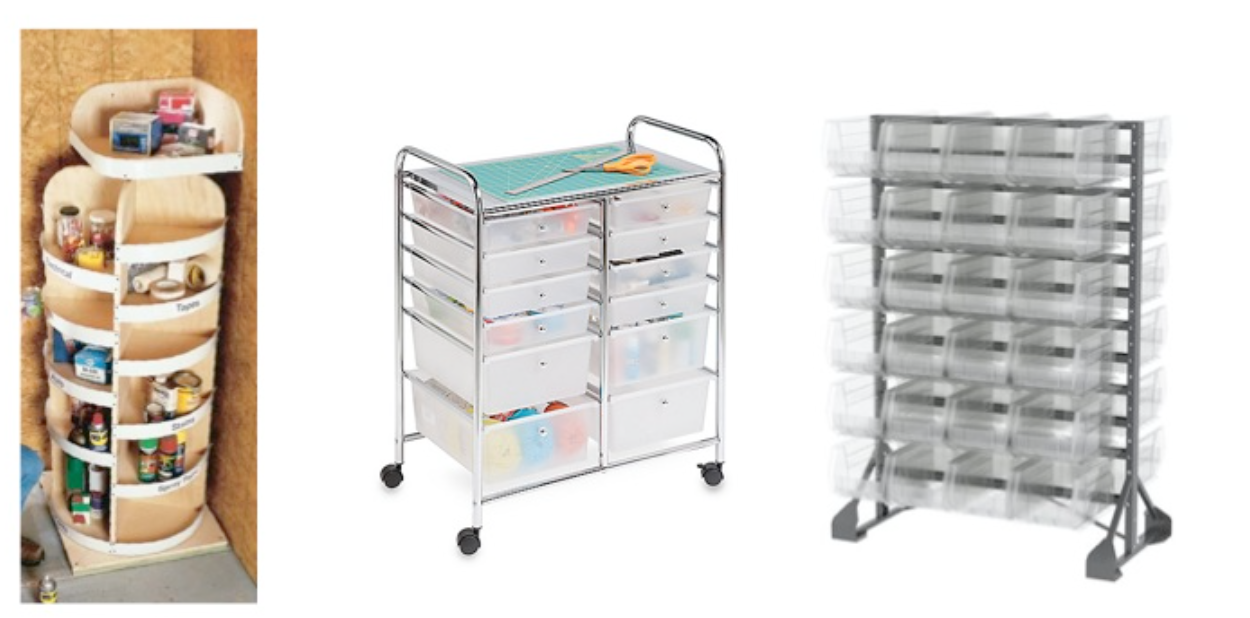
Creativity Labs research team (lead by Dr. Kylie Peppler) gave input into the design of the space. Opportunities to brainstorm and ideate various aspects of the physical space occurred during a graduate level apprenticeship course that also included an excursion to a new Teen Media Space in the Monroe County Public Library, that is designed based on a connected learning model. Many of the suggestions and ideas of the graduate students made it into the blue prints of the makerspace, and will be included in the construction that is planned to start this summer. The features that graduate students contributes include open and transparent storage opportunities and the need for mobile and reconfigurable furniture to expand accessibility. Much of the labs work this year focused on properties of materials. The need for open and inviting storage options to clearly see materials was a key factor in the design.


Examples of portable and transparent storage for easy access to materials

The paper prototype above shows the layout of the space that is planned to combine two smaller rooms into one longer space. The prototype helped mediate the furniture selection and configuration process. It also represents a key design features of the space that was milled over by the Creativity Labs team to further substantiate transparency: one entire wall will be glass. Clear and see-through storage can be pushed against the glass, affording passers-by to see materials at a glance, encouraging and calling them to enter.

Architects, Interior designers, Electricians, Representatives of deans council, SOE donors and more – Some additional aspects of collaboration that occurred throughout the design of the space was the involvement of many other stakeholders in and out of the School of Education. University architects, interior designers, electricians, etc. were regularly met with to plan and design the space and the unique furniture needs for the space. Representatives of the IU School of Education Deans council were brought in early to discuss the possibility of faculty research grants for the makerspace. Additionally, potential donors for the School of Education were contacted about sponsorship and future funding for the space. The amount of collaboration among a wide variety of people was essential in spreading the vision for the space and ensuring its future success.


If you want to learn more about Makerspaces in Schools of Education visit the websites of

Please let us know of any other makerspaces in Schools of Education you might have heard of!

Anna Keune & Justin Whiting