Showing posts with label School of Education. Show all posts

Monday, June 8, 2015

Creativity Labs Learns to Knit


This is the second in a series of blog posts about the Creativity Labs’ fiber arts summer workshops. The workshops are experiential opportunities to learn new crafting skills, which have connections to the current Re-Crafting Education project. We are learning from and working with experienced crafters in the community to strengthen our understanding of and connection to the regional fiber arts community.

In this second workshop, the Creativity Labs team took on the next fiber arts challenge during a group knitting lesson at Yarns Unlimited in downtown Bloomington, IN. The local yarn shop has been a key site for observation and instruction during the Re-Crafting project, and offers both a rich collection of beautiful, soft and colorful materials and fiber arts classes for crafters in the community, including knitting, crocheting, and weaving among many more. In addition to the playful storefront, where fibers, yarns and felt as well as knitting needles of all sizes and books inspire to make, the shop contains a classroom dedicated to fiber arts lessons.


The crafting classroom at Yarns Unlimited. 

The teaching staff comprises of passionate, skilled and dedicated knitters, crocheters, and weavers. Our instructor, Karen Canapa, has been knitting and crocheting most of her life, attesting to its therapeutic benefits. She works with fiber artists of all levels, but is particularly patient throughout the (sometimes frustrating) first minutes of a new knitter’s quest to get in the loop. Her extensive work with beginner knitters has given her the opportunity to observe and to design effective and fun instructions for a knitter’s first lesson. 

Here is a glimpse of what we learned when we picked up our needles:
  • The Slip Knot: To start a new project, the knitter can make the first loop to slip onto the knitting needles. This loop is called a slip knot, and the yarn “slips” right onto the needle as the knitter prepares the project. Karen warned us that the slip knot can be “super tricky” to make - we agree with her! 
“The [slip knot] is a small knot that leaves a loop on one end,” Karen explained, “and if you pull the two ends, the knot completely disappears. So, it allows us to have a variable size beginning stitch.”

From left to right: Karen shows Anna another variation of the slip-knot technique. Sophia practices making slip knots in the crafting classroom. 
  • The Cast-On: The first row of a knitted project is the row that is cast onto the needle by the knitter. The knitter will put both needles into the slip knot to make an “X” shape. 
 

From left to right: Putting the needles through the slip knot. Folding the yarn over the needle to prepare for the first stitch. Starting the second row of stitches.
  • The Knit and Purl: Knitting consists of two basic stitches: knit stitches and purl stitches. The first stitch the beginner knitter learns is the knit. A series of knit stitches is called the garter stitch pattern. We learned to knit a few rows of knit stitches. We also worked together fix some of our mistakes. In doing so, we were able to see that knitting is actually a process of crafting that generates loops, instead of knots (as some may think). A row of stitches is essentially a connected line of loops! After learning the knit stitch, Karen taught us the purl stitch, which can be thought of as a reverse knit stitch.

Sophia learns to knit and purl across the row on her stitches.  

These 3 techniques work together to form a knitter’s first tool kit. The knit stitch itself can be used to create an extensive collection of projects. Together, we learned that the first moments of knitting can be complex and challenging, but as one of us (Kate) writes about in her first weeks as an embedded knitter, mistake-making is a valuable component of the learning process. Karen recommends 15 minutes of practice a day to develop a natural flow to your knitting practice. It may only be a matter of time before the Creativity Labs knits a matching team uniform.


Thursday, April 30, 2015

The MILL: A Makerspace for Pre-Service Teachers at Indiana University


With Indiana’s pre-service teacher applications in decline and makerspaces on the rise, there is a need for the IU School of Education to update their approaches to attract and prepare a new generation of teachers for the kinds of challenges they may face in their career. At the same time, makerspaces need educators that come into the spaces with ideas for facilitating holistic and diverse making based on educational theories and practices learned at their university. 

Makerspaces in higher education institutions make it possible for pre-service teachers to use the kinds of tools and materials that can regularly be found in makerspaces but have not been traditionally integrated in learning spaces like classrooms and pre-school but are more frequently being integrated in formal and informal learning spaces, such as libraries, museums and schools. Pre-service teachers can try out making models with 3d printers, craft projects with the laser cutter, assemble electronic circuits, or simply design and prototype with common materials like cardboard or legos. By exploring the materials and tools and letting the material guide their ideas for learning opportunities and educational adventures, pre-service teachers can practice those skills that are in demand in makerspaces that all too often do not have curricular based on educational theory. These explorations can support teachers in taking back charge of the design of learning.

During the 2014-2015 school year, Dr. Kylie Peppler led an interdisciplinary faculty committee within the School of Education at Indiana University that began an initiative to design and build a makerspace in the School of Education.  A space suitable for innovating, collaborating, creating, prototyping, learning and general making. The result will be the MILL (Make Innovate Learn Lab) and renovations are set to happen this summer 2015. We are beyond excited about having the new space!

 As the We had the opportunity to tag-along, observe, and participate. In relation to the DML commons unit of co-design and collaboration in DBR, we think this is an interesting example of how interdisciplinary collaboration and pushing of institutional boundaries happened in a shared effort to setting the foundation for making the vision a reality. We outline here key decisions and practices we observed that seemed to have been instrumental for co-constructing a coherent narrative vision for and around the space and for laying the infrastructure for the successful continuation of this collaborative endeavor.

MILL Space Committee includes representatives from Science Ed, Art Ed, Instructional Systems Technology, Learning Sciences, the Office of Instructional Consulting, Education Technology Services & other School of Education departments. This collaborative committee effort underlined the message for the makerspace to serve the needs of several departments in the IU School of Education. The primary objective of the committee is to extend collaboration across school departments and to enrich the vision for the space from diverse educational perspectives coming from students and faculty. A large part of the committee conversations centered around the makerspace as a place to make stuff AND to represent a starting point for shifting the culture in the IU School of Education. In particular, the idea was to encourage thinking about challenges and design opportunities while making and engaging with material prototypes. While the makerspace is primarily aimed at the students, staff and faculty of the IU School of Education, the committee frequently thinking about how the space can extend the reach of collaboration to community partners and local K-12 schools.


A cardboard prototype of portable and transparent storage that can slide under a counter

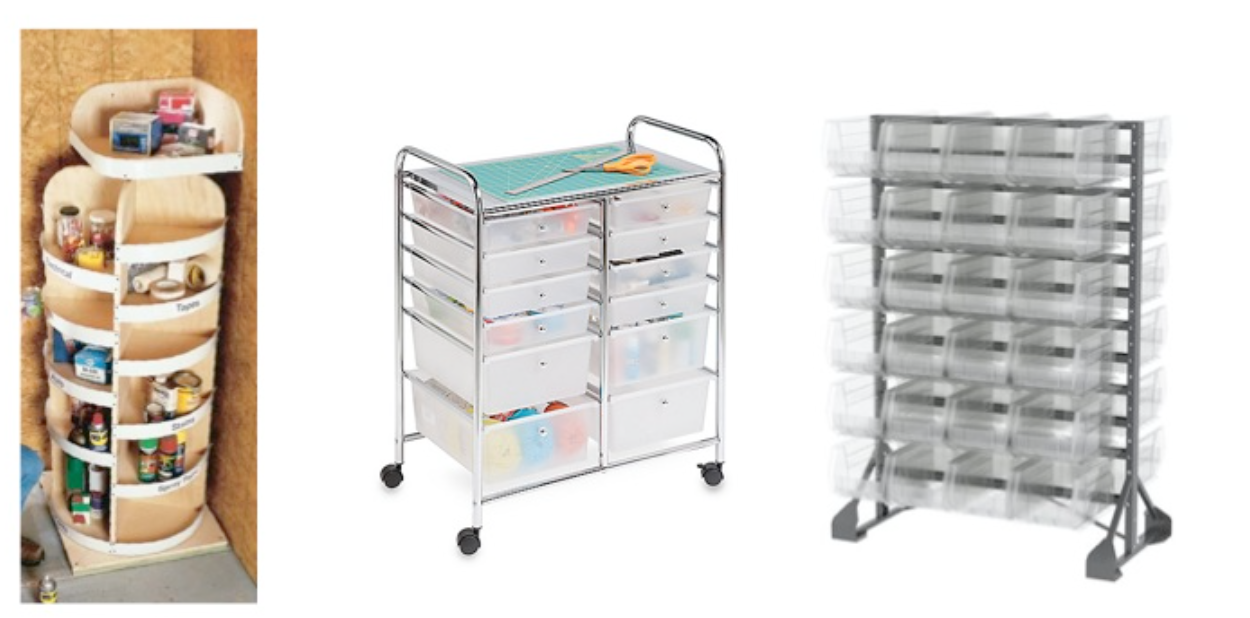
Creativity Labs research team (lead by Dr. Kylie Peppler) gave input into the design of the space. Opportunities to brainstorm and ideate various aspects of the physical space occurred during a graduate level apprenticeship course that also included an excursion to a new Teen Media Space in the Monroe County Public Library, that is designed based on a connected learning model. Many of the suggestions and ideas of the graduate students made it into the blue prints of the makerspace, and will be included in the construction that is planned to start this summer. The features that graduate students contributes include open and transparent storage opportunities and the need for mobile and reconfigurable furniture to expand accessibility. Much of the labs work this year focused on properties of materials. The need for open and inviting storage options to clearly see materials was a key factor in the design.


Examples of portable and transparent storage for easy access to materials

The paper prototype above shows the layout of the space that is planned to combine two smaller rooms into one longer space. The prototype helped mediate the furniture selection and configuration process. It also represents a key design features of the space that was milled over by the Creativity Labs team to further substantiate transparency: one entire wall will be glass. Clear and see-through storage can be pushed against the glass, affording passers-by to see materials at a glance, encouraging and calling them to enter.

Architects, Interior designers, Electricians, Representatives of deans council, SOE donors and more – Some additional aspects of collaboration that occurred throughout the design of the space was the involvement of many other stakeholders in and out of the School of Education. University architects, interior designers, electricians, etc. were regularly met with to plan and design the space and the unique furniture needs for the space. Representatives of the IU School of Education Deans council were brought in early to discuss the possibility of faculty research grants for the makerspace. Additionally, potential donors for the School of Education were contacted about sponsorship and future funding for the space. The amount of collaboration among a wide variety of people was essential in spreading the vision for the space and ensuring its future success.


If you want to learn more about Makerspaces in Schools of Education visit the websites of

Please let us know of any other makerspaces in Schools of Education you might have heard of!

Anna Keune & Justin Whiting